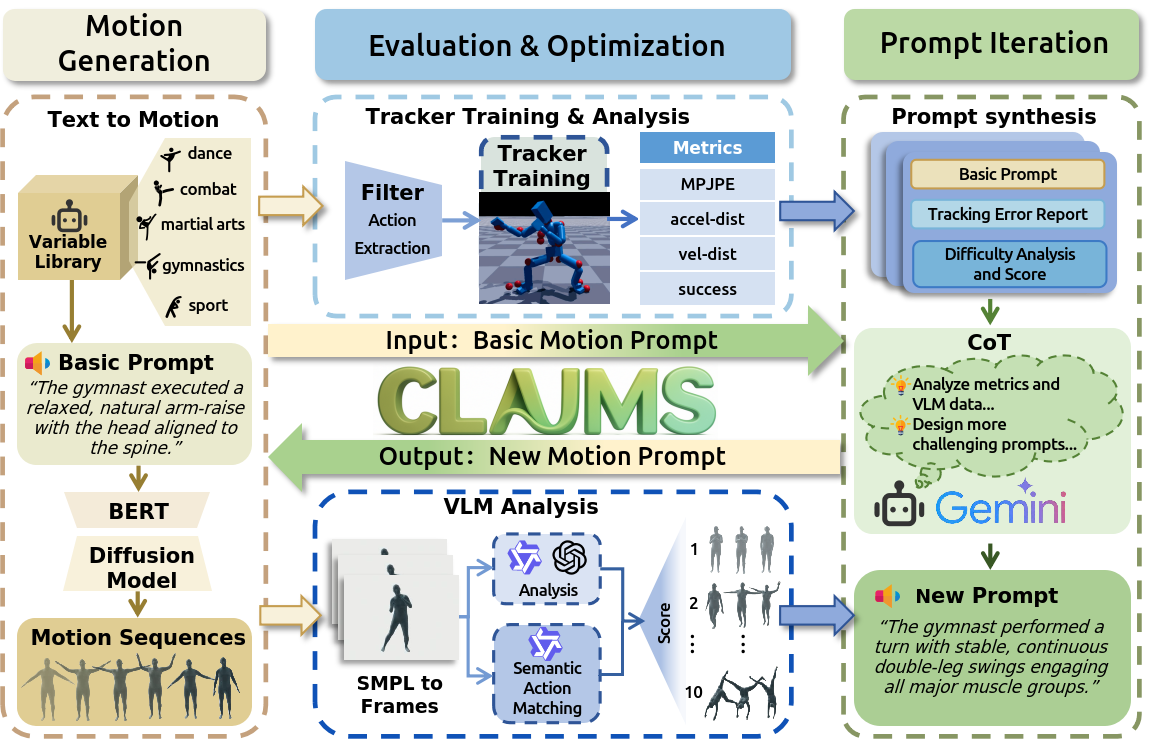
Physics-based humanoid control relies on training with motion datasets that have diverse data distributions. However, the fixed difficulty distribution of datasets limits the performance ceiling of the trained control policies. Additionally, the method of acquiring high-quality data through professional motion capture systems is constrained by costs, making it difficult to achieve large-scale scalability.
To address these issues, we propose a closed-loop automated motion data generation and iterative framework, CLAIMS. It can generate high-quality motion data with rich action semantics, including martial arts, dance, combat, sports, gymnastics, and more.
Furthermore, our framework enables difficulty iteration of policies and data through physical metrics and objective evaluations, allowing the trained tracker to break through its original difficulty limits. On the PHC single-primitive tracker, using only approximately 1/10 of the AMASS dataset size, the average failure rate on the test set (2201 clips) is reduced by 45% compared to the baseline.
Comparing tracking performance of different training loops (L0, L3, L6) across escalating difficulty levels.
Reference Motion
L0 Tracker
L3 Tracker
L6 Tracker (Ours)
Reference Motion
L0 Tracker
L3 Tracker
L6 Tracker (Ours)
Reference Motion
L0 Tracker
L3 Tracker
L6 Tracker (Ours)
Comparing our final L6 Tracker with the PHC baseline on out-of-distribution dynamic motions.
Reference
PHC Tracker
Ours (L6)
Reference
PHC Tracker
Ours (L6)
Reference
PHC Tracker
Ours (L6)
Reference
PHC Tracker (Fail)
Ours L6 (Fail)
Showcasing the diversity of our generated high-quality action semantics.
Combat
Dance
Gymnastics
Martial Arts
Sports
Combat
Dance
Gymnastics
Martial Arts
Sports
@inproceedings{xu2026iterative,
  title={Iterative Closed-Loop Motion Synthesis for Scaling the Capabilities of Humanoid Control},
  author={Xu, Weisheng and Wu, Qiwei and Zhang, Jiaxi and Tan, Jing and Li, Yangfan and Fang, Yuetong and Xiong, Jiaqi and Wu, Kai and Ou, Rong and Xu, Renjing},
  booktitle={Proceedings of the IEEE/CVF Conference on Computer Vision and Pattern Recognition},
  pages={16398--16407},
  year={2026}
}